
Vacuum Lift vs Hydraulic Lift: Which Is Better for Chennai Homes?
Share
Save
Listen to this Article
For most Chennai homes — especially existing duplexes, villas, and G+1 structures being retrofitted — vacuum (pneumatic) lifts are the better choice. They require no pit, no machine room, install in 24–48 working hours, cost ₹0 in civil work, and handle power failures automatically. Hydraulic lifts suit new builds with pre-planned shafts or very high load requirements.
Picture this: you've finally decided to install a home lift. You call a few companies, and suddenly you're drowning in opinions. One says hydraulic is the gold standard. Another swears by vacuum technology. Your contractor has never heard of pneumatic lifts.
Here's what most comparison pages won't admit upfront — brands that sell hydraulic lifts say hydraulic is better; brands that sell vacuum lifts say vacuum is better. We make vacuum lifts at Nibav. You know that. But we'll also tell you when hydraulic genuinely wins, because the right answer depends on your home, not on anyone's sales target.
How Each Technology Works
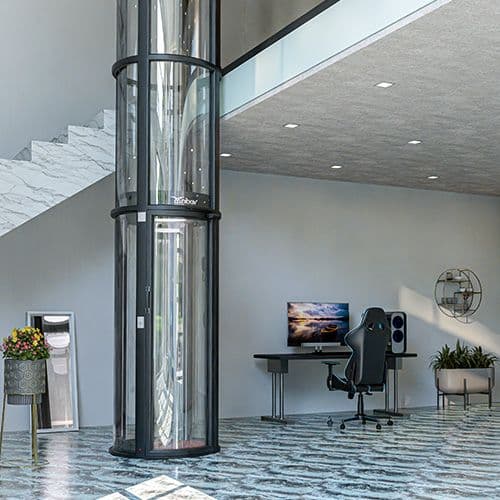
Vacuum (Pneumatic) Lift: A transparent polycarbonate cylinder houses the cabin. A pump removes air from above, creating a pressure difference that draws the cabin upward. To descend, air is reintroduced gradually — gravity does the work, consuming zero electricity on the way down. No grease. No pit. No machine room. Entirely self-contained.
Hydraulic Lift: A pump pushes hydraulic fluid into a cylinder, raising a piston that lifts the cabin. The pump and fluid reservoir sit in a machine room. A pit beneath the lowest floor accommodates the piston. The pump runs in both directions.
These two core engineering differences cascade into every real-world contrast that follows.
Why Chennai Is Different from Any Other City
Chennai's specific conditions make this comparison uniquely important here:
Coastal and Variable Soil: Parts of South Chennai — Adyar, Thiruvanmiyur, Velachery, ECR — sit on sandy, waterlogged subsoil. Pit excavation for hydraulic lifts in these zones isn't just expensive; it's geotechnically risky. Unexpected water table encounters, soil collapse during digging, and mandatory pit lining and waterproofing can push civil costs from ₹2 lakhs to ₹5+ lakhs. Vacuum lifts require zero pit excavation — this is a genuine structural advantage in Chennai, not just a marketing claim.
Frequent Power Interruptions: Tamil Nadu's residential power supply, while improved, still sees interruptions during peak summer months. When a hydraulic lift loses power, the cabin locks in position. Someone must manually release a valve to bring it down — which requires either a trained person or waiting for a technician. A vacuum lift automatically descends to the nearest floor the moment power fails. The door opens. The passenger walks out. For a city where power cuts remain a real variable, this passive safety difference matters every single day.
Home Typology: Chennai has a high concentration of G+1 and G+2 independent houses, duplexes, and villas — particularly in T. Nagar, Anna Nagar, Mylapore, Velachery, and OMR. These are exactly the homes where retrofit installation is common, space is at a premium, and 3–8 weeks of hydraulic installation is maximally disruptive.
Head-to-Head Comparison: What Actually Matters
Installation in an Existing Chennai Home
Installing a hydraulic lift in an existing Chennai home requires pit excavation (600–1500 mm) in variable soil, machine room construction (2–4 sq m), and 3–8 weeks of active construction — with dust, noise, and disruption throughout. Civil costs add ₹2–5 lakhs on top of the unit price. Installing a vacuum lift requires only a clean circular cutout between floor levels. Assembly takes 24–48 working hours. No additional civil costs. Your home stays functional throughout.
Energy Efficiency
Vacuum lifts use electricity only going up. Descent consumes zero electricity — physics does the work. Hydraulic systems run the pump in both directions. Over 10–15 times of daily use across 365 days in a Chennai summer, the cumulative difference in your electricity bill is real.
Eco-Friendliness
This matters more than most comparison articles acknowledge. Hydraulic lifts use oil as operating fluid. That oil degrades over time, requires replacement every 3–5 years, and poses disposal challenges. In Chennai's summer heat, poorly ventilated machine rooms with aging hydraulic fluid can generate unpleasant odours indoors. Vacuum lifts use compressed air. No grease. No chemicals. No disposal concerns. No odour. From an environmental standpoint, air-driven technology is genuinely cleaner — throughout the product lifecycle, not just in marketing materials. If sustainable living matters to your household, this is a decisive difference.
Safety Record
Both technologies include door interlocks, overload protection, and child safety locks. The critical difference is the power failure scenario.
Hydraulic during power cut: Cabin holds position. Manual valve release required to descend. Someone must know how — or you wait for a technician. Vacuum during power cut: Cabin automatically descends to the nearest floor. The passenger walks out unaided. No tools. No knowledge required. For Chennai families where elderly residents or children use the lift, the automatic-descent safety behaviour of vacuum lifts is not a minor feature — it is the most important safety distinction in daily use.
Maintenance Over 10 Years
Hydraulic lifts require oil replacement every 3–5 years, regular pump and motor servicing, and seal inspections. AMC costs tend to be higher due to oil-system complexity. Vacuum lifts have no lubricant. Fewer moving parts mean fewer failure points. On Nibav Series V, the motor and vacuum seal carry a 25-year warranty — the longest available on any home lift in India. No competitor offering hydraulic lifts can match this because no lubricant-based system has the component durability of a well-engineered vacuum system.
Aesthetics Inside Your Chennai Home
A hydraulic lift is enclosed in metal or opaque panels. It works. It does not enhance the space.
A vacuum lift is a transparent polycarbonate cylinder — panoramic, illuminated, and screwless. In a South Chennai villa or an Anna Nagar duplex, that visible difference is felt every single day. It doesn't occupy your interior; it becomes part of it.
When Hydraulic Is Still the Right Answer
An honest guide says this clearly. Hydraulic lifts genuinely make more sense when:
- You need very high load capacity (above 250 kg) for specific requirements
- You are building a new home from scratch with a dedicated shaft planned from the start
- A site assessment reveals structural constraints preventing a circular floor cutout
For the vast majority of Chennai homeowners in existing G+1 or G+2 villas and duplexes, none of these apply.
Nibav Vacuum Home Lifts: Chennai's Most Trusted Air-Driven Brand
Nibav has a dedicated experience centre in Chennai with installations across T. Nagar, Anna Nagar, Adyar, Velachery, OMR, and ECR. Every model is TÜV NORD certified, installed without a pit or machine room, and is backed by 24/7 local support. Explore our full range of home lift models to find the one built for your home. Or compare Standard vs Max variants if you're unsure which cabin size suits your family.
Book a free Nibav home assessment — a specialist visits your space, evaluates your floor plan and ceiling height, and gives you an honest recommendation with no obligation.
Frequently Asked Questions
- Is a vacuum lift better than a hydraulic lift for a Chennai home? -
For most Chennai homes — especially retrofit installations in existing duplexes and villas — vacuum lifts win on almost every practical dimension. They require no pit (critical given Chennai's variable soil), no machine room, install in 24–48 working hours instead of 3–8 weeks, add ₹0 in civil costs, use zero electricity on descent, and descend automatically during power failures without any manual intervention.
- Are vacuum lifts eco-friendly compared to hydraulic lifts? -
Yes, significantly. Vacuum lifts use compressed air with no grease, no hydraulic fluid, no chemical disposal requirements, and zero energy on descent. Hydraulic lifts use oil that degrades over 3–5 years, needs periodic replacement, and can generate odour in poorly ventilated machine rooms during Chennai's hot months. For households prioritising sustainability, this is a meaningful real-world difference.
- Which is safer during Chennai's power cuts — vacuum or hydraulic? -
Vacuum lifts are safer during power failures. The cabin automatically descends to the nearest floor under controlled air pressure — no tools, no technician, no waiting. Hydraulic lifts lock in position during power failure and require a trained person to manually release a valve. For elderly residents or children using the lift alone, this safety difference is significant.
- Do vacuum lifts have vacuum leakage issues as some competitors claim? -
This claim comes from brands selling hydraulic lifts and is not supported by engineering evidence. Modern vacuum seals from certified manufacturers are precision-engineered to international standards. Nibav's Series V motor and vacuum seal carry a 25-year warranty — if vacuum leakage were a recurring problem, no manufacturer could offer this. Always ask any brand: what is your warranty on core components?
- What is the total cost difference between vacuum and hydraulic lifts in Chennai? -
Unit prices are comparable — vacuum lifts from ₹11,49,000, hydraulic from approximately ₹12,00,000. However, hydraulic lifts add ₹2–5 lakhs in civil work (pit excavation, machine room). Over 10 years, hydraulic systems also cost more in oil servicing, higher AMC rates, and energy use. Total cost of ownership consistently favours vacuum lifts for G+1 and G+2 Chennai homes.
- Can a vacuum lift be installed in a small Chennai plot in localities like T. Nagar or Mylapore? -
Yes. Nibav's most compact model requires just 1000 mm of clear floor space with an external diameter of 935 mm. It fits beside staircases, in corners, and within the typical layout of older Chennai independent houses in T. Nagar, Mylapore, and Triplicane — with no structural modification beyond a single circular floor cutout.