
Can You Install a Home Lift in an Existing House in Chennai Without Construction?
Share
Save
Listen to this Article
Yes — you can install a home lift in an existing Chennai house without major construction. Air-driven (pneumatic) vacuum lifts are self-supporting, require no pit, no machine room, and no shaft. The only modification needed is a clean circular cutout between floor levels. Installation completes in 24–48 working hours with no welding, drilling of walls, or civil contractors.
Most Chennai homeowners who want a home lift share the same fear: "My house is already built. This is going to mean breaking floors, months of construction, dust everywhere, and a bill that triples before it's done."
That assumption stops more home lift decisions than any other factor. And for years, it was partially true — because traditional lifts genuinely required all of that. But that's not the full picture in 2026. Technology has changed, and with it, what's possible in your home.
Why the Old Assumption Was True — and Why It Isn't Anymore
Traditional hydraulic and traction elevators were engineered for commercial buildings. They depend on deep pits, reinforced concrete shafts, and dedicated machine rooms. Retrofitting these into an existing Chennai home required:
- Breaking the ground floor slab to excavate a 600–1500 mm pit
- Constructing a masonry shaft through multiple floors
- Building a machine room (2–4 sq m) with dedicated wiring
- Structural engineers, civil contractors, and weeks of occupation
For an occupied home in Velachery or Mylapore, this was genuinely impractical — not just inconvenient, but structurally risky and financially punishing. What changed is the arrival of air-driven home lifts — a technology designed from the ground up for residential retrofit installations.
How Air-Driven Home Lifts Work Without Construction
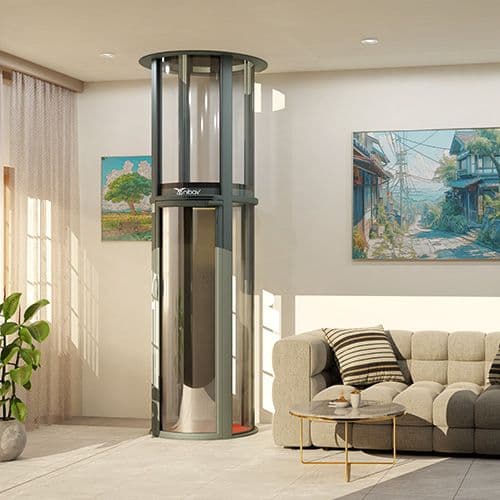
A pneumatic vacuum lift is a self-supporting unit. It doesn't rely on your walls, beams, or floor for structural support. Here's how installation works in an existing Chennai home:
Step 1 — Site Assessment A Nibav specialist visits your home, measures floor-to-floor height, ceiling clearance, and identifies the best position (corner, beside staircase, or centre of a room). This takes 30–60 minutes and is completely free.
Step 2 — Floor Cutout The only structural modification: a precise circular hole is cut between the ground floor ceiling and first floor slab. This is clean, controlled, and takes a few hours. No breaking walls. No excavation. No structural reinforcement required.
Step 3 — Assembly The lift arrives in a pre-manufactured CKD (Completely Knocked Down) kit. Engineers assemble the cylinder sections floor by floor — like building a Lego structure. No welding, no drilling into walls, no ducting work.
Step 4 — Electrical Connection A standard single-phase power connection is all that's needed — the same as your air conditioner or washing machine. No three-phase industrial supply. No new meter.
Step 5 — Testing and Handover Safety tests are run, the lift is calibrated for floor levelling, and you receive an operations walkthrough. Total time: 24 to 48 working hours from start to handover.
Your family can continue living in the home throughout. No displacement. No hotel bills. No months of dust.
What Space Does a Retrofit Lift Need in Chennai Homes?
This is the practical question most homeowners ask next. Here's the honest answer:
- Minimum floor space: 1000 mm (about 3.3 feet) for compact models
- Maximum for larger cabin models: 1430 mm
- Ceiling height: Minimum 2,436 mm per floor level (standard in most post-2000 Chennai construction)
Common locations in Chennai homes where retrofit lifts are installed:
- The corner beside the staircase (most popular)
- A corner of the living room or entrance foyer
- Replacing an underused storage alcove
- Against an external wall with a small attached structure
Over 90% of Chennai's G+1 and G+2 independent houses and duplexes have at least one location that meets these requirements. A site assessment confirms the optimal position.
Real Scenario: A Chennai Duplex in Adyar
Consider a family in Adyar with an elderly parent living on the ground floor and the main family on the first floor. The staircase is the daily connection — and increasingly, a daily concern.
With a pneumatic lift installed in the corner beside the staircase:
- The site assessment took one morning
- A circular cutout was made in the floor/ceiling junction
- Assembly ran across two working days
- On Day 3, the family did their first ride
The parent now moves between floors safely and independently. The staircase is still there as backup. The lift blends into the home's corner with a polished screwless finish. No pit was dug. No wall was broken. The family was home throughout.
This is not a hypothetical — it's the standard Nibav installation experience across hundreds of Chennai homes.
Key Safety Features in a Retrofit Air-Driven Lift
A lift installed in your home needs to be as safe as one built into a new construction. Nibav's air-driven lifts include:
- Automatic emergency descent: Power fails → cabin gently descends to nearest floor, door opens, passenger exits unaided
- Battery 2.0 backup: Keeps lights, fan, and cabin electronics running during power cuts
- Door safety interlocks: Lift moves only when all doors are fully closed and locked
- Smart Overload Alert: Lift won't operate if weight exceeds safe capacity
- Child Safety Lock: Restricts unauthorized operation
- Brake 3.0: Instant, precision stopping at every floor
- TÜV NORD certification: European safety standard — the same benchmark as commercial lifts in Germany and the UK
The lift is safe from Day 1. Not because of the building it's in, but because of the safety engineering built into the product.
Nibav Home Lifts: Built for Exactly This Situation
Every Nibav home lifts model is engineered for retrofit installation in existing Chennai homes. No pit. No machine room. 2–5 days. Self-supporting.
- Series III Standard – ₹11,49,000 | 749 mm cabin, 210 kg, perfect for compact plots
- Series III Max – ₹14,49,000 | 1160 mm cabin, 240 kg, wheelchair-accessible
- Series IV Standard – ₹15,49,000 | 830 mm, Motor 2.0, Quiet 3.0, premium finishes
- Series IV Max – ₹18,49,000 | 1240 mm, 77% ROS, ideal for families
- Series V Standard – ₹19,49,000 | AutoGlide™ auto-opening doors, ZeroTrace™, 25-yr warranty
- Series V Max – ₹22,49,000 | Flagship, HeartLine™ engraving, SmartConnect™ emergency comms
Explore space-saving models for Chennai homes or discover the full premium range here.
The question isn't whether your home can have a lift. It's which model fits it best. Book your free Nibav site assessment — a specialist visits, assesses, and gives you an honest answer within one day.
Frequently Asked Questions
- Can a home lift really be installed in an existing Chennai house without major construction?-
Yes. Pneumatic vacuum lifts are self-supporting and require no pit, no machine room, and no masonry shaft. The only structural work is a circular cutout between floor levels — clean, precise, and completed in a few hours. Full installation is done in 24–48 working hours while the family continues living at home.
- What is the minimum space required in my Chennai home for a retrofit lift? -
Compact models need as little as 1000 mm (3.3 feet) of clear floor space. Larger cabin (wheelchair-accessible) models need 1430 mm. The most common installation positions are beside the staircase or in a corner of the living area. A free site assessment confirms the exact feasibility and best location for your home.
- Does a retrofit home lift in Chennai require any special electrical connections?-
No. Nibav's air-driven lifts run on standard single-phase power — the same supply that powers your air conditioner or refrigerator. No three-phase industrial connection, no upgraded meter, and no special wiring beyond a dedicated circuit breaker, which your electrician can set up in under an hour.
- How long will installation disrupt daily life in my Chennai home?-
Installation takes 24–48 working hours with no displacement required. Your family lives in the home throughout. There is no welding, no drilling into walls, and no civil contractors involved. The only work is a floor cutout and modular assembly — both clean and contained.
- Are home lifts installed in existing Chennai houses as safe as those in new construction? -
Yes. Safety in a Nibav lift is built into the product, not the building. Every model is TÜV NORD certified, including automatic emergency descent, battery backup, door interlocks, overload protection, and child safety lock — regardless of whether it's installed in a new build or a 20-year-old duplex in Mylapore.
- What happens if I want to move homes after installing a lift? -
Nibav lifts are built on a CKD (Completely Knocked Down) design — fully relocatable. The lift can be dismantled and reinstalled in your new home. You're not locked into one property, which makes it a lifetime asset rather than a fixed installation.