Share
Save
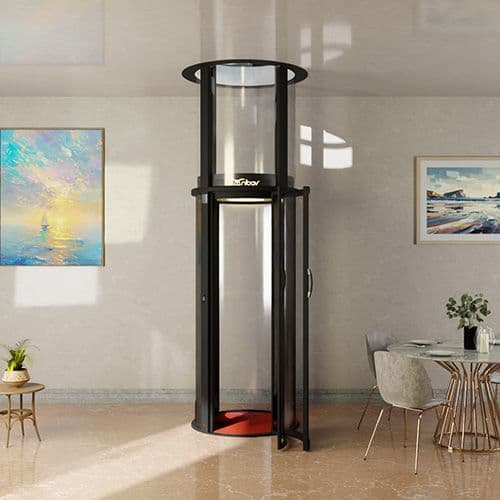
Chennai homeowners know the space challenge better than most. Whether it's a villa on a 30×40 site in Velachery, a G+2 independent house in Tambaram, a duplex in OMR, or a compact multi-storey home in Anna Nagar — the city's residential fabric is built vertically, and the plots those vertical homes sit on are rarely generous.
When the conversation turns to home elevators, space anxiety is the first barrier that surfaces. Most Chennai families imagine the worst-case scenario: a large shaft consuming a corner of every floor, a machine room eating into the ground floor layout, weeks of construction in a home that's currently occupied and functioning.
That picture is outdated — and it's stopping families from making a decision that would immediately and meaningfully improve daily life. Space-saving home elevators in Chennai in 2026 require as little as 1010 mm of clear floor space, no pit, no machine room, and be installed in 24–48 working hours. This guide gives you the complete picture.
Chennai's residential development pattern creates a specific set of space constraints that make compact elevator technology more relevant here than in almost any other Indian city.
Plot sizes are smaller than the aspiration. The classic Chennai villa dream — an independent house with a garden, a car porch, and multiple floors — is increasingly built on 600–1200 sq ft plots. The vertical build compensates for the limited ground footprint, but it also means that every square foot on each floor has been planned and allocated.
Construction is dense. In areas like Adyar, Nungambakkam, Kilpauk, and the extended suburbs along the GST Road and OMR corridors, homes are built close together. Adding a traditional elevator shaft with surrounding masonry walls often creates proximity issues with neighbouring structures that simply don't exist with a self-supporting vacuum elevator system.
Renovation disruption is high-stakes. Chennai families live in their homes continuously. A construction project that runs for weeks in an occupied house — with elderly parents, children, and daily routines to maintain — creates disruption that most families are genuinely reluctant to accept. The 24–48 hour installation timeline of a compact vacuum elevator changes this calculation entirely.
The most important numbers for Chennai homeowners evaluating a compact home elevator:
| Model | Clear Floor Space | Machine Room | Pit | Cabin Diameter |
| Series III Standard | 1010 mm (3.3 ft) | None | None | 749 mm |
| Series IV Standard | 1000 mm (3.3 ft) | None | None | 830 mm |
| Series III Max | 1430 mm (4.7 ft) | None | None | 1160 mm |
| Series IV Max | 1430 mm (4.7 ft) | None | None | 1240 mm |
| Series V Standard | 1000 mm (3.3 ft) | None | None | 830 mm |
| Series V Max | 1430 mm (4.7 ft) | None | None | 1240 mm |
The complete footprint for a standard compact model — 1010 mm clear diameter — is smaller than a standard Chennai bathroom. It fits in corners, staircase voids, car porches, and utility passages that most homeowners have available without affecting any living space.
The transparent polycarbonate shaft means the elevator doesn't create visual mass or block light in the space it occupies. For Chennai's sun-lit interiors where natural light is carefully managed, this is a meaningful aesthetic advantage over any opaque shaft system.
Home elevator prices in Chennai vary based on model, number of floors, and finish choices. Here is the current Nibav range — the most complete compact vacuum elevator product line available in the Chennai market:
| Series | Model | G+1 Starting Price |
| Series III | Standard | ₹11,49,000* |
| Series III | Max | ₹14,49,000* |
| Series IV | Standard | ₹15,49,000* |
| Series IV | Max | ₹18,49,000* |
| Series V | Standard | ₹19,49,000* |
| Series V | Max | ₹22,49,000* |
Important for Chennai buyers: these are all-inclusive prices. There is no pit excavation cost to add, no machine room construction, no structural shaft walls. The price you see is the complete installation price.
This is a meaningful distinction from traditional elevator quotes in the Chennai market, which often show a unit price and separately bill ₹4–8 lakhs in civil work. Always ask for an all-in quote before comparing.
Prices are starting rates, exclude applicable taxes, and may vary based on customisation.
Chennai's typical home architecture creates specific placement opportunities that compact vacuum elevators are well-suited to:
Car Porch Installation
In the classic South Indian villa design — ground floor car porch, first floor living areas — the car porch provides an ideal location for the elevator base. The shaft rises from the car porch floor through an opening in the first floor slab, emerging cleanly in the living area or passage above. The car porch remains functional around the shaft's 1010 mm footprint, and no interior living space is consumed.
This is the most popular configuration for compact Chennai villa installations, and it makes intuitive sense: the car porch is covered, structurally sound, and not interior living space.
Under the Staircase Void
Most Chennai independent houses have a staircase void — the space beneath the flight of stairs — that is either left open or used informally for storage. In many cases, this void has exactly the footprint needed for a compact elevator. The shaft rises through the staircase floor opening to the upper level, and the staircase continues to function fully alongside it.
Corner of the Ground Floor Passage
In Chennai homes with a ground floor entrance passage or foyer, a 1010 mm circular footprint in the corner of that space accommodates a compact elevator without affecting the passage's function. The transparent shaft becomes a visual feature of the entry rather than an obstruction.
Pooja Room or Storage Area Relocation
In some Chennai homes — particularly older structures — a ground floor pooja room or storage area can be repurposed to house the elevator, with the religious space relocated to an equally accessible position. This is a structural decision that a site assessment can evaluate.
Understanding the real buyer profile for compact home elevators in Chennai helps frame the decision for homeowners who are still evaluating.
Families with elderly parents in multi-storey homes are the dominant buyer segment. Chennai has a large, established population of senior citizens living in independent houses that were built for active families — and are now occupied by couples or individuals for whom the stairs have become a daily challenge.
Working professionals in their 40s who are planning ahead — installing a compact elevator now, during a home renovation, before mobility becomes a concern. This segment has grown significantly in Chennai's OMR and Perambur tech corridors.
NRI families returning to Chennai or maintaining a family home for parents who live independently. The 24–48 hour installation makes it achievable during a short India visit, and the low-maintenance air-driven technology means parents can operate it reliably without regular servicing needs.
Villa developers and builders in Chennai's premium residential markets — Sholinganallur, Perungudi, Neelankarai, ECR — who are incorporating home elevators as a standard premium feature in their villa projects.
Post-surgery households where a family member has undergone knee replacement, hip surgery, or a cardiac procedure and cannot manage stairs during recovery or long-term.
Chennai's coastal humidity and high temperatures — regularly exceeding 38–40°C during April and May — create specific challenges for mechanical systems.
Hydraulic elevator systems use fluid-driven pistons with seals and hoses that degrade faster in high-humidity, high-temperature conditions. Regular fluid maintenance is required, and seal replacement frequency increases in Chennai's climate.
Vacuum home elevators have no hydraulic fluid, no fluid seals, and no hoses. The primary mechanical components — the turbine motor and the vacuum seal — are unaffected by Chennai's humidity or temperature in the way that fluid-based systems are. This translates directly to lower maintenance costs and longer component life in Chennai's specific climate.
Nibav is headquartered in Chennai — at Neelankarai — with an experience centre where you can step into a working elevator, feel the ride quality, and speak to a specialist who knows the city's home architecture intimately.
Every model in the range is designed for compact Indian homes. Every model is pitless, machine-room-free, and TÜV NORD Certified. Every model installs in 24–48 working hours. And the range spans from the compact Series III Standard (₹11,49,000*, 1010 mm footprint) to the flagship Series V Max (₹22,49,000*, full wheelchair access, 25-year motor and seal warranty, auto-opening doors).
For Chennai homeowners who have been waiting for a home elevator that actually fits — the answer is already here.
1010 mm clear floor diameter for the Series III and Series V Standard models — smaller than a standard Chennai bathroom. No pit or machine room space required. This is the complete footprint.
Nibav's compact home elevators in Chennai start at ₹11,49,000* for a G+1 installation (Series III Standard, all-inclusive). The full range goes up to ₹22,49,000* for the Series V Max. All prices exclude taxes and are starting rates for G+1 configuration.
24–48 working hours for most Chennai residential installations. No pit, no machine room, no structural changes. The home remains fully liveable throughout the installation.
Yes. Nibav's vacuum home elevators are pitless and self-supporting — they require only clean circular floor openings at each level and single-phase electrical connection. No structural walls are removed, no foundations are touched.
Yes. Every Nibav model includes automatic emergency descent and Battery 2.0 backup — the cabin descends safely to the nearest floor with lighting and ventilation active when power is cut.