Share
Save
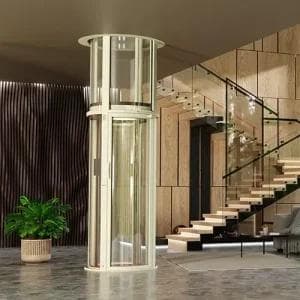
You wouldn't think twice about fitting a modern kitchen or a premium bathroom — investments that improve daily life and add lasting value to your home. But when a home elevator comes up in conversation, it still gets filed under "luxury" rather than "essential." That framing is changing rapidly — and the families who have made the shift are consistently the ones who say they wish they'd done it sooner.
The advantages of home elevators go well beyond convenience. They touch on safety, independence, property value, and the daily quality of life for every member of a multi-storey household. This guide covers all of them — completely, honestly, and specifically for the Indian residential context.
Falls on residential staircases are one of the leading causes of serious injury among elderly Indians. A steep staircase, a poorly lit landing, a moment of fatigue or distraction — the risk is daily and cumulative.
A home elevator eliminates this risk entirely for the vertical journey between floors. The enclosed cabin, automatic door locks, and sensor systems mean that every trip between floors is actively protected — not left to chance, balance, and the grip of a railing.
For families with elderly parents — particularly in Chennai's multi-storey villas and Mumbai's duplexes — home elevator safety is not a secondary consideration. It is often the primary reason the decision gets made.
Key safety systems in certified home elevators include:
There is a quiet, gradual process that happens in many Indian multi-storey homes: the elderly resident begins to self-restrict. The upper floor bedroom becomes less visited. The terrace garden is abandoned. The prayer room on the first floor is accessed less and less. Not because the desire to go there is gone, but because the stairs have become a daily negotiation.
A home elevator gives that independence back — completely. Every floor of the home becomes equally accessible, without planning, without assistance, without anxiety. For a 75-year-old who has lived in the same Chennai villa for 30 years, that return of full access to their own home is not a minor quality-of-life improvement. It is a fundamental restoration of dignity.
The upfront cost of a home elevator is the number most people focus on — and it is real. Nibav's range starts at ₹11,49,000* for a G+1 installation. The natural question is whether that investment returns value.
It does — in two ways:
Daily lifestyle value: From day one, the elevator improves the quality of daily life for every user in the household. The elderly parent who regains full floor access. The family member recovering from surgery doesn't have to plan every trip between floors. The parents who stop worrying about their child on the stairs. These returns begin immediately and compound over years.
Property value: A certified home elevator — particularly a transparent, premium-finish vacuum elevator — adds measurably to residential property value in India's premium markets. In Chennai's OMR and Anna Nagar villa markets, in Bangalore's Whitefield and Sarjapur corridors, and in Mumbai's western suburbs, a home elevator is increasingly viewed as a premium baseline feature that expands the buyer pool and supports higher comparable pricing at resale.
Prices are starting rates, exclude taxes, and vary based on model and configuration.
Expanding on the property value point: the buyer who is purchasing a multi-storey home in 2026 is not the same as the buyer of 2010. Ageing parents, return from international assignments, future-proofing for personal mobility — these considerations are actively factored into residential purchase decisions at the premium end of the Indian market.
A home with a certified, well-installed home elevator is accessible to a wider buyer pool than an equivalent home without one. In premium villa and duplex markets across Chennai, Bangalore, and Mumbai, this expanded addressable market is a pricing advantage that sellers consistently benefit from.
For households with a wheelchair user — whether permanent or following surgery — a home elevator transforms what the home can offer. Without a lift, a wheelchair user is effectively restricted to whichever floor their bedroom is on. The rest of the home becomes inaccessible.
A wheelchair-accessible home elevator (Max models with 1160–1240 mm cabin diameter) allows a wheelchair user and their attendant to travel between every floor of the home independently. No transfer. No assistance required for the journey itself.
This isn't just a quality-of-life advantage — it is the difference between a home that works for the whole family and one that inadvertently isolates a family member.
Modern vacuum home elevators require no pit excavation and no machine room construction. This is an advantage that directly affects who can practically benefit from a home elevator — which, in India's context of millions of existing multi-storey homes, means the vast majority of homeowners.
The elimination of pit and machine room requirements means:
For Indian homeowners who assumed a home elevator "wouldn't work in their existing house," this is the advantage that removes the barrier entirely.
Modern vacuum home elevators consume electricity only during ascent. Descent is powered by gravity and controlled air valve regulation — zero electricity required.
For a typical Indian family using the lift 10–15 times daily, estimated monthly electricity consumption: ₹200–400. That is less than many home appliances that run continuously. Over a decade of daily use, the cumulative running cost of a vacuum home elevator is a fraction of what traditional hydraulic systems require.
In a country where electricity costs are rising and power quality is variable, an inherently energy-efficient technology is both an economic and a practical advantage.
A home elevator that sounds like a machine every time it operates is not the same as one that doesn't. The most advanced vacuum home elevators — with Quiet 3.0 technology, Suspension 2.0 damping, and isolation-mounted motor systems — operate at approximately 55 dB. That is quieter than a normal conversation.
For Chennai homes where multi-generational families share floors, for Mumbai apartments where noise carries, and for any home where peace and calm are valued, a near-silent home elevator is not a trivial consideration. It is part of what makes the installation feel like it belongs in the home — not like a mechanical addition to it.
A properly certified home elevator with built-in child safety features is safer than the staircase it supplements. The Child Switch prevents independent operation by young children. Triple-layer door detection halts the doors on any obstruction. Smart Overload Alert prevents overcrowding. Automatic emergency descent removes the risk of entrapment during power cuts.
These are not add-ons or optional packages. In certified home elevator ranges, they are standard engineering — present in every model, regardless of price point.
This advantage is underappreciated until you see it in person. A transparent polycarbonate vacuum home elevator does not consume visual space — it passes light between floors, maintains visual openness, and integrates with the surrounding interior as a design element.
Premium finish options — leather cabin interiors, metallic and hydro-gloss shaft exteriors, ambient cabin lighting, laser-engraved personalisation, illuminated ceiling features — mean the elevator can be specified to complement any interior direction. Many Chennai and Bangalore architects now position the elevator as the central visual feature of a villa's staircase void, rather than concealing it.
Nibav's home elevator range — Series III through Series V Max — is designed to deliver all ten advantages described above in a single product, certified to international standards, and installed in any existing Indian home in 24–48 working hours.
TÜV NORD Certification. Pitless, machine-room-free design. Standard child safety features across every model. Energy-efficient vacuum technology. Transparent panoramic cabin design. 20+ colour and finish options. And for the flagship Series V models: auto-opening doors, 25-year motor and seal warranty, integrated emergency communication, and laser-engraved cabin personalisation.
Starting from ₹11,49,000* for a G+1 installation — all-inclusive, no civil work additions.
For most Indian families, the biggest advantage is safety and independence for elderly residents — eliminating the daily fall risk on staircases and restoring full floor access to family members who have been quietly self-restricting due to mobility challenges.
Yes — particularly in premium villa and duplex markets in Chennai, Bangalore, Mumbai, and Hyderabad. A certified, well-designed home elevator expands the buyer pool and supports premium pricing versus comparable homes without one.
Modern vacuum home elevators consume power only during ascent — descent requires zero electricity. Estimated monthly running cost for typical Indian household use: ₹200–400.
Nibav's range starts at ₹11,49,000* for the Series III Standard (G+1, all-inclusive). The flagship Series V Max starts at ₹22,49,000* (G+1). Prices exclude taxes and vary based on model, floors, and customisation.
Yes — TÜV NORD Certified home elevators with built-in child safety systems (Child Switch, triple-layer door detection, automatic emergency descent, overload protection) are significantly safer for vertical travel than the staircases they supplement.